
Choosing the right snow chain size sounds simple until you actually try to buy a set.
Many buyers start with the vehicle model or wheel diameter. However, a snow chain is fitted around the actual tire, not simply the car itself. Two vehicles with similar wheel sizes can require completely different snow chains, while the same vehicle model may use several tire sizes.
The good news is that you do not need to guess. With the right information, choosing the correct snow chain becomes much easier.
1. Start With the Tire Size, Not the Vehicle Model
The first and most important number is the tire size printed on the sidewall.
You may see something like:
205/55 R16
This number tells you three important things:
- 205 = tire width in millimeters
- 55 = aspect ratio
- R16 = 16-inch rim diameter
When ordering snow chains, provide the complete tire size rather than simply saying “16-inch tires.”
For example, a customer driving a vehicle with 16-inch wheels could have 205/55 R16, 215/55 R16 or 225/50 R16 tires. These tires are not the same size, even though they all use a 16-inch wheel.
For distributors and importers, this is particularly important. A product listed only by vehicle model can create unnecessary fitment problems when customers use different tire configurations.
2. Check the Vehicle Manufacturer’s Requirements
Tire size is only half of the answer.
Before selecting a snow chain, check the vehicle owner’s manual or the manufacturer’s instructions. Some vehicles have limited space between the tire and suspension, brake components or inner wheel housing.
This is known as chain clearance.
A vehicle manufacturer may specify which tire and wheel combinations can use snow traction devices and may provide specific instructions for their installation and use. European vehicle regulations also address the compatibility of snow traction devices with approved tire and wheel combinations.
This is especially important for modern vehicles with larger wheels, low-profile tires or limited wheel-well clearance.
So the safest approach is:
Check the tire size → check the vehicle manual → then choose the chain.
Do not assume that a chain will fit simply because the tire dimensions look correct.
3. Match the Chain Size Range Carefully
Snow chains are normally designed to cover a defined range of tire sizes.
For example, one chain specification may cover several compatible tire dimensions, while another model may be designed for a narrower range.
This is why the manufacturer’s size chart matters.
For DURVOR metal snow chains, for example, different chain specifications can be developed around different tire sizes and vehicle applications. When discussing a bulk order, providing the complete tire-size range helps us recommend the appropriate product specification rather than simply choosing a chain based on the vehicle name.
For B2B buyers, this information is also useful when building a product range. Instead of stocking dozens of individual products without a clear system, it is better to understand which chain specifications cover the most relevant tire sizes in your target market.
4. Consider the Type of Vehicle
The correct size is not the only consideration. The construction of the snow chain should also match the vehicle.
A small passenger car normally has different requirements from a commercial truck.
For passenger cars and SUVs, buyers may prioritize:
- Easy installation
- Compact storage
- Reliable traction
- Lower noise
- Tire protection
- Suitable clearance
For trucks and commercial vehicles, durability, traction and resistance to repeated use may become more important.
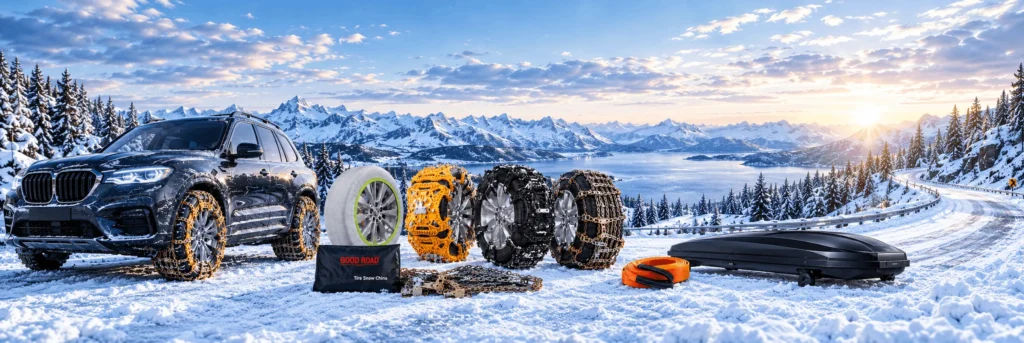
DURVOR supplies different traction solutions for these applications, including metal snow chains, TPU snow chains and snow tyre socks.
Our metal snow chains use steel construction and are available in different specifications for different tire applications. TPU snow chains provide a more flexible alternative for suitable passenger vehicles, while snow tyre socks offer a lightweight textile solution for customers who prioritize easy handling and compact storage.
5. Metal Chains and TPU Chains Do Not Have the Same Fitment
One common mistake is assuming that different types of snow chains can share the same size simply because they are intended for the same tire.
In practice, the construction and dimensions of the traction device matter.
A traditional metal snow chain has a chain structure that wraps around the tire. The chain diameter, link configuration and tensioning system all affect the final fit.
TPU snow chains use a different construction. Their flexibility and component design mean that the size range should be checked according to the manufacturer’s specifications.
For this reason, do not transfer a size from a metal chain directly to a TPU product without checking the applicable size chart.
6. What Information Should You Send a Supplier?
If you are not sure which snow chain to order, you do not need to measure everything yourself.
For the fastest product recommendation, send your supplier:
1. Complete tire size
Example: 205/55 R16
2. Vehicle make and model
Example: Volkswagen Golf
3. Model year, if available
This can help identify different wheel and clearance configurations.
4. Intended application
Passenger car, SUV, van, truck or commercial vehicle.
5. Target market
Europe, North America, Australia or another market.
6. Required quantity
This is particularly important for distributors and wholesalers because the recommended product range may depend on the number of tire sizes you need to cover.
If possible, a clear photo of the tire sidewall is also extremely useful.
7. Do Not Choose a Larger Chain “Just to Be Safe”
This is another common misunderstanding.
A larger chain is not automatically safer or easier to install.
If the chain is too loose, it may not sit correctly on the tire. If the construction is not suitable for the vehicle’s available clearance, it may create contact with components around the wheel.
The goal is not to find the biggest chain that can physically be installed.
The goal is to find the correctly matched snow traction device for the specific tire and vehicle.
8. Check Local Road Requirements Before Use
Fitment is not the only thing to check before a winter trip.
Snow chain requirements can vary by country, road and weather conditions. For example, European countries may have different winter-equipment requirements, and local signs or road conditions can determine when chains must be carried or used. EU travel guidance for Croatia, for example, specifies particular winter-equipment requirements for certain periods and conditions.
Therefore, drivers should check the rules for their destination and planned route rather than relying on a general statement about “European snow chain regulations.”
A Simple Snow Chain Size Checklist
Before placing an order, check these five points:
✓ Tire size
Read the complete size from the tire sidewall.
✓ Vehicle compatibility
Check the owner’s manual for snow-chain or snow-traction-device requirements.
✓ Available clearance
Make sure the selected chain construction is suitable for the vehicle.
✓ Product specification
Use the manufacturer’s size chart rather than guessing from wheel diameter.
✓ Local requirements
Check the winter-equipment rules for your destination.
Need Help Choosing the Right Size?
If you are buying snow chains for your own vehicle, start with the tire size printed on the sidewall.
If you are a distributor, wholesaler or importer, send us your target tire-size range, vehicle applications and estimated quantity. DURVOR can help review the appropriate product specifications and discuss OEM, private-label and packaging requirements.
For a quick product check, you can also send us a photo of the tire sidewall.
Choosing the right snow chain is not about finding the biggest or most expensive option. It is about matching the tire, vehicle, clearance and intended use with the right product specification.