
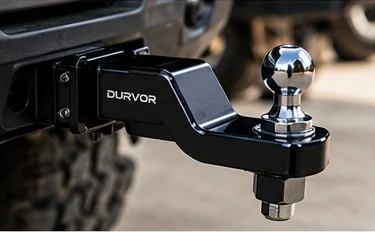
Specifying a tow bar for a trailer fleet is not hard, but it is easy to get wrong in a way that only shows up when someone tries to hitch up at 6am.
The details matter because a tow bar is a connection between two things that rarely match perfectly: a vehicle and a trailer. Get the ball size wrong and nothing connects. Get the drop length wrong and you scrape the tongue on every driveway. Get the weight rating wrong and you have a safety problem, not a convenience problem.
Here is what actually needs to be decided, and in what order.
1. Start with the trailer, not the vehicle
The trailer tells you two hard numbers: the coupler size and the gross trailer weight (GTW). Everything else is negotiable around those.
Coupler size is the boring part, and it matters most. Nearly everything sold today in North America uses a 2-inch ball for light trailers and a 2-5/16 inch ball for anything heavier. There are still 1-7/8 inch couplers out there on old equipment, so check before you quote.
GTW is the trailer with everything loaded in it: cargo, fuel, gear, animals. The tongue weight is roughly 10 to 15 percent of that, and that is the number the tow bar has to carry.
2. Match the vehicle receiver
The receiver on the tow vehicle has its own size, and it is not related to the ball size. Common receiver sizes are 2 inch and 3 inch, with 1-7/8 inch showing up on older light-duty trucks.
A common mistake in fleet purchasing is ordering by ball size. A 2-5/16 inch ball still needs a 2 inch receiver, because the ball mount and the receiver are different interfaces. You need both numbers.
A useful check before you order anything: look at the hitch receiver itself, not the vehicle brochure. It is stamped or labelled with the size on the side.
3. Work out the drop and rise you need
Drop is the distance from the bottom of the receiver down to the center of the ball. Rise is the distance the ball sits above the receiver opening. Both are usually measured in inches and both are quoted with the tow bar length.
The practical constraint is usually the trailer tongue. If the ball sits too low, the coupler hits the ground on steep driveways. If it sits too high, the trailer frame hits the rear bumper or the exhaust.
Measure from the top of the receiver to the top of the trailer coupler on a level surface, then subtract the coupler height. That gives you the drop you need. It takes five minutes and saves a return shipment.
4. Check the weight ratings line up
Three numbers get confused here, so it is worth separating them.
- Tongue weight is what the hitch carries. This is the number the ball mount and the ball are rated for.
- Trailer weight rating (TWR) is the maximum trailer the vehicle is rated to tow.
- Max gross trailer weight is the heaviest trailer, loaded, that the combination can handle.
The tow bar’s own working load limit has to cover the tongue weight with margin, and the vehicle’s TWR has to cover the loaded trailer. A tow bar rated 18,500 lbs is a strong tow bar, but it does not make a 6,000 lb-rated vehicle able to pull more than the vehicle allows.
5. Pick the ball configuration for how the fleet actually works
Once the numbers are settled, the ball layout comes down to how many different trailers the unit needs to handle on any given day.
A single-ball mount handles one configuration. A dual-ball mount, with one 2 inch ball and one 2-5/16 inch ball, covers most fleets that move between light and heavy trailers. A tri-ball arm adds a third position, usually a low drop for clearance, which is where multi-axle and off-road work starts to matter.
For fleets running on-road with two trailer types, dual-ball is the sensible default. If the fleet handles off-road recovery, boats, or equipment with a low tongue, the extra ball position earns its cost quickly because swapping tow bars is not something a driver does in a parking lot.
6. Materials and finish, and why they differ by duty
Carbon steel handles the load and survives being dropped, dragged, and left outside. Aluminium cuts weight, which matters when the tow bar hangs off the back of a vehicle all day, and it resists corrosion well without coating.
Finishes follow the same logic. Powder coating handles road salt and general weather for steel parts. Polished or plated finishes are common on aluminium and on exposed ball surfaces where a coating would not hold anyway.
One practical note for anyone specifying for a fleet: the ball surface itself is a wear item. It takes the load through the coupler every time, and on a ball that gets used daily, a chrome or zinc finish is worth the small cost difference.
7. What to ask a manufacturer before you commit
If you are buying direct rather than through a distributor, the questions worth asking early are specific.
- What is the actual working load limit, and is it tested or calculated?
- Does the ball mount fit the receiver sizes I need, and can it be adjusted?
- What certifications do you hold, and can you provide test reports?
- What is the minimum order quantity and the lead time for a custom run?
- Can you produce private label packaging and documentation for my market?
That last one matters more than it sounds. If you are building a product line rather than reselling a catalogue item, you need a supplier who can do OEM and ODM runs, and who understands that a packaging layout and a test report are part of the deliverable.
A short checklist
Before a tow bar goes on a purchase order, confirm all of these:
- Coupler size on the trailer
- Gross trailer weight and resulting tongue weight
- Receiver size on the tow vehicle
- Required drop, measured not estimated
- Ball configuration matching the trailer types in use
- Tow bar working load limit above the tongue weight, with margin
- Vehicle towing rating above the loaded trailer weight
- Material and finish matched to the duty and the environment
Get those eight right and a tow bar is a straightforward purchase. Get one of them wrong and you eat the cost in downtime, returns, or a failed inspection.